.webp)
The Rise of AI Agents in Financial Decisioning
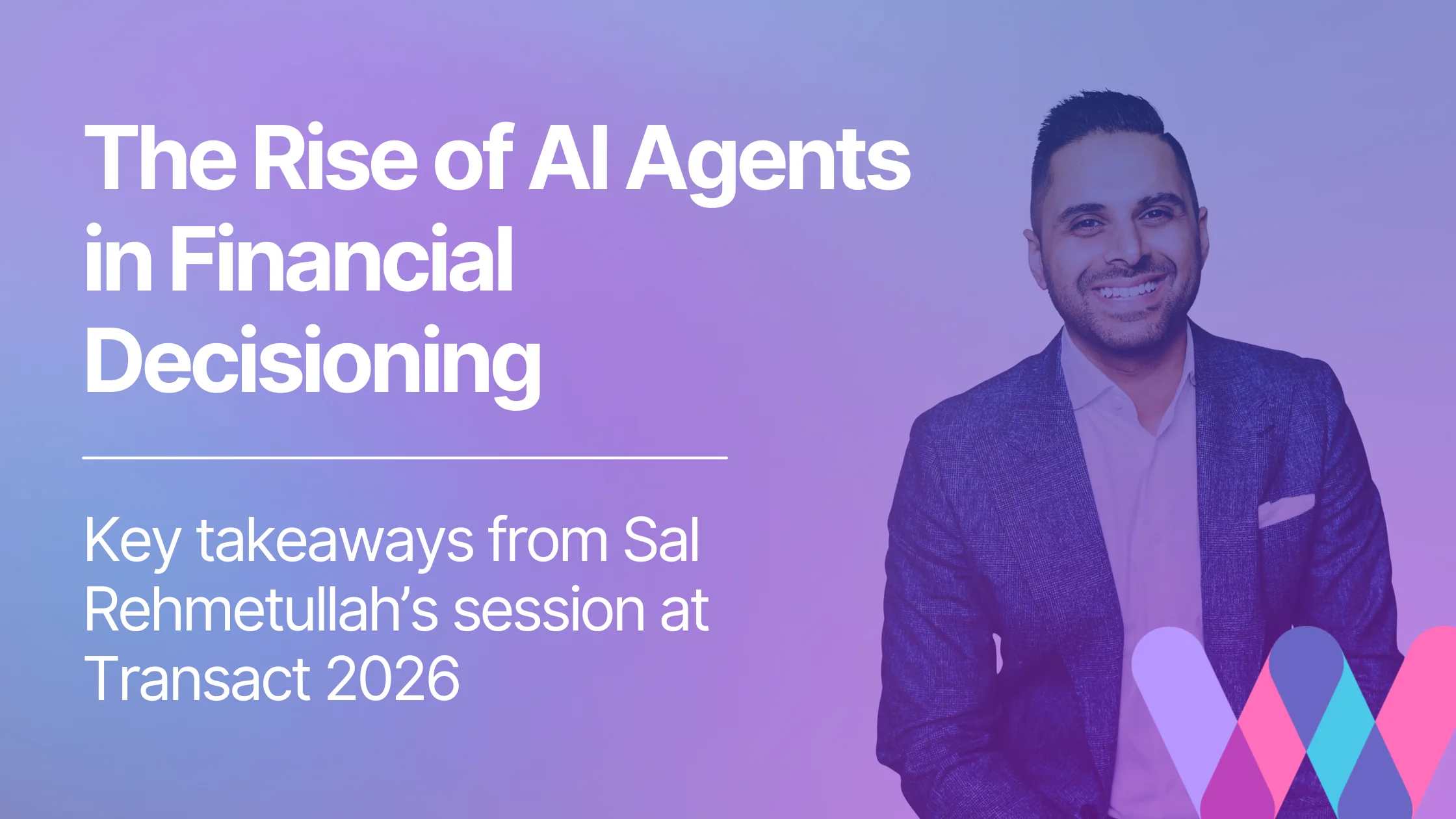
For the Worth team, a highlight of Transact 2026 was CEO Sal Rehmetullah sitting down with Nima Montazeri, Chief Product & Technology Officer at Liberis, to share perspectives on where onboarding and underwriting are headed. The conversation focused on what financial institutions need to rethink in light of rising expectations for speed, accuracy, and risk, as well as how AI agents are reshaping decision-making.
Below is a recap of the session, featuring key excerpts and the main takeaways from the discussion.
The shift from assistance to action
“Agents are about autonomous decision-making, how they can act on your behalf within guardrails. Co-pilots help you make decisions, but agents can actually make them.”
— Sal Remetullah, Worth Co-founder and CEO
For years, innovation in this space has focused on making processes more efficient by aggregating data, streamlining workflows, and giving underwriters better tools. But those systems still rely on humans to interpret and act. What’s changing now is the role software, specifically agentic AI, can play in the decision itself.
An important distinction that Sal described is between co-pilots and agents. Co-pilots help surface information, while agents can take action within defined guardrails. That shift may sound incremental, but it fundamentally changes how onboarding and underwriting can operate at scale.
Solving the inconsistencies that stall approvals
“How do you ask for the least amount of information from the customer while giving the most to the underwriter to make a decision?”
Today, much of the friction in onboarding and underwriting processes comes from relatively small inconsistencies. A business might apply under a DBA that doesn’t exactly match its registered name. An address might differ slightly across systems. A piece of information might be missing or formatted incorrectly.
Each of these issues, on its own, is minor, but in practice, they trigger manual reviews, follow-ups, and delays that extend timelines from minutes to days.
Agents can resolve many of these issues in real time. They can reconcile mismatched data, pre-fill or correct application inputs, and pull from additional sources, such as tax transcripts, to verify information without requiring more from the applicant. Instead of stopping the process when something doesn’t line up, the system can continue moving forward, filling in gaps as it goes.
Traditional models and rules-based systems are effective for the majority of straightforward cases. But there’s always a portion that falls outside those boundaries. Some applications require a deeper look at financials, supporting documents, or less structured data. Historically, those cases have been handed off entirely to manual review.
Agents introduce a middle layer. They can interpret documents, synthesize fragmented information, and build a more complete view of a business before a human ever needs to step in. The result is what Sal and Nima described as a “higher-resolution picture” of risk.
Instead of relying on a narrow set of inputs, financial institutions can evaluate businesses with more context — looking across financial history, operational signals, and broader indicators that reflect how a business actually performs over time. That added clarity allows institutions to move faster without taking on additional risk.
The next evolution of small business infrastructure
“Every business is going to have an agent that represents it, just like they have a website or social presence today.”
One of the more forward-looking ideas discussed in the session is the concept of businesses being represented by their own agents. Just as having a website or social presence has become standard, businesses may soon have digital counterparts that can interact directly with financial systems.
In that model, applying for financial services could become continuous and automated. An agent could initiate applications, provide supporting data, and respond to requests without requiring the business owner to manually manage each step. That shift introduces new questions around verification and trust.
If an agent is acting on behalf of a business, financial institutions need a way to confirm that authority. This is where emerging frameworks like Know Your Agent (KYA) are beginning to take shape, extending the principles of identity verification into a world where autonomous systems are participating directly.
As with any meaningful shift in financial infrastructure, adoption won’t happen all at once. The path forward is iterative. It starts with automating smaller, well-defined use cases. For example, reducing manual work in low-risk, high-impact areas. From there, those capabilities can be used to build new products, and eventually, entirely new categories.
Why black-box decisions won’t work
“The world of black-box decision-making can’t exist here. You need full traceability into why a decision was made.”
In highly regulated environments, decisions cannot be opaque. They must be auditable and understandable. As agents take on a larger role, that requirement becomes even more critical.
The ability for an agent to act independently introduces new risks if not properly constrained. Guardrails must be clearly defined to ensure agents operate within strict boundaries and don’t take unintended actions. Additionally, every decision must be traceable. Financial institutions need the capability to track what decision was made and why.
The institutions that navigate the frontier of agentic AI the fastest won’t be the ones that automate most aggressively, but those that do so thoughtfully, pairing speed with control and innovation with accountability.
As Sal explained during the discussion, what’s emerging is not a better version of the current process, but a different model entirely. One where decisions are no longer delayed by fragmented systems or manual intervention, but are resolved in real time, with the full context required to get them right, and increasingly, one in which agents are part of how those decisions are made.
Learn more about the future of Decision Intelligence at Worth here.



.webp)


